By Markian Melnyk, Realtor
Owners and buyers of homes near Chesapeake Bay need to know whether their property is regulated under the Chesapeake Bay Critical Area Protection Act. The act restricts development and land use to protect habitat and resources in and around the bay.
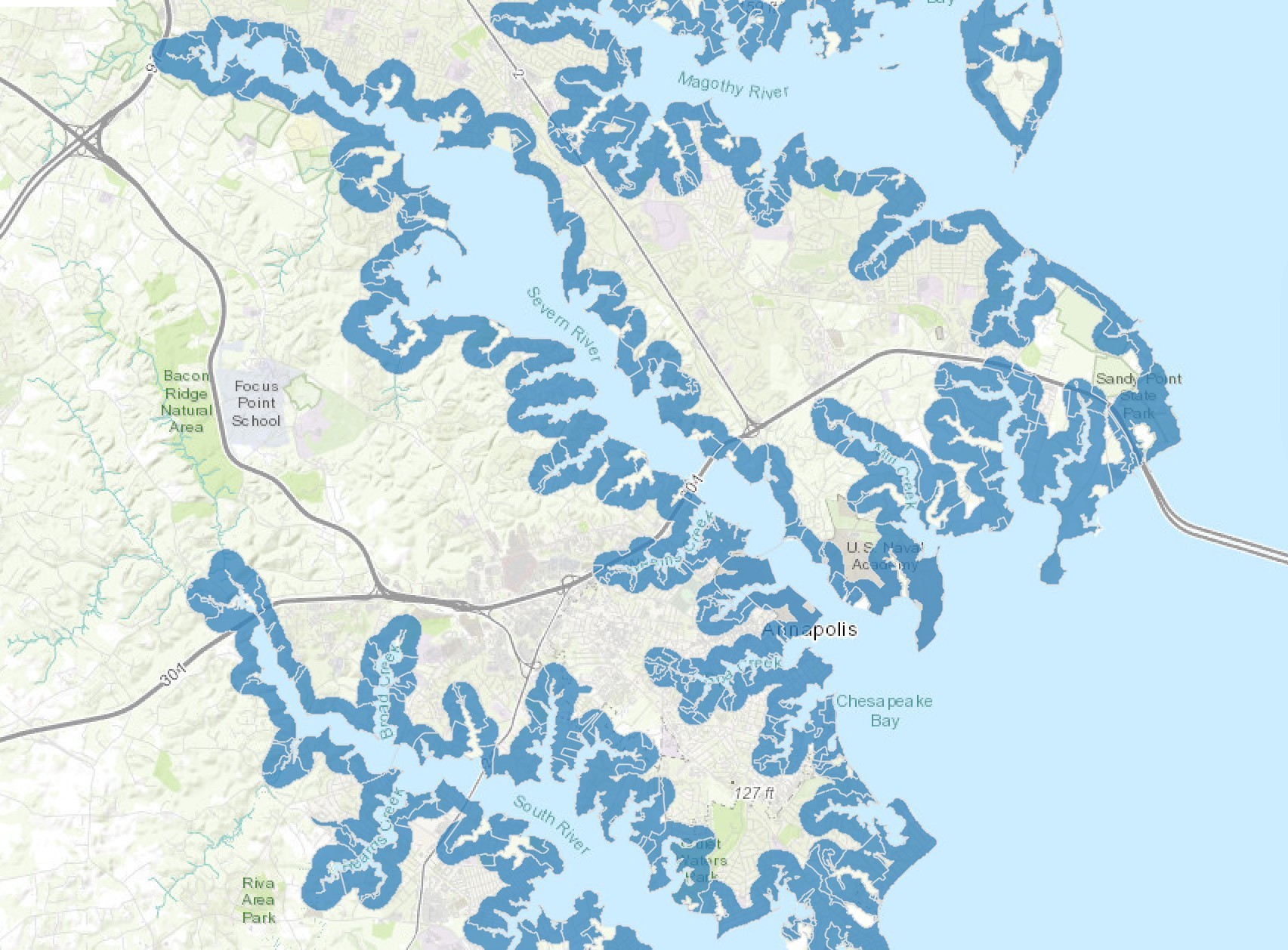
The critical area extends 1,000 feet inland of the average high-water line of tidal waters or the edge of tidal wetlands and all waters of and lands under the bay and its tributaries. That last element of the definition, referring to tributaries, can catch many by surprise. The Bay has over 11,000 miles of shoreline, including its tributaries, in Maryland alone. A home that appears to be located well inland may still be close enough to a tributary of the bay to be subject to this law. If in doubt, check the county critical area map like the one shown above (see, https://opendata.aacounty.org/).
The law controls development as well as the use and maintenance of a property. For example, constructing a dock will require permits from the county and the Army Corps of Engineers. Or how about clearing trees and shrubs around your property to build a paved path? The critical area rules address the preservation of native vegetation along a buffer of 200 feet from the mean high-water line landward. And the amount of impervious surface coverage is also restricted. In Anne Arundel County where Annapolis is located impervious surfaces are limited to 15% to 31% of the total site area, depending on whether the property is classified as a limited development area or a resource conservation area.
Septic systems are another consideration for properties within the critical area. A new or replacement septic system must use the best available technology (BAT) to control the leakage of nitrogen pollution into the Bay. A BAT system typically adds $12,000 to $18,000 to the cost of a standard septic system installation and it also costs more to operate.
It is said that oysters were once so plentiful that when Captain John Smith explored the Chesapeake in the 1600s, tall oyster reefs physically obstructed ship navigation. A single adult oyster can filter up to 50 gallons of water daily and oyster reefs were once able to filter the entire volume of water in the bay once every three to four days. Oyster reefs controlled the sediment and nutrient runoff from the bay’s watershed and provided habitat for many bay species, including blue crabs, and striped bass (rockfish). Today’s oyster population is estimated at 1%-3% of historical levels, making it critical to take extra measures to control the runoff of pollutants and nutrients into the bay.
The Chesapeake holds a central place in Maryland’s state identity. And when you become a homeowner in the bay’s critical area, you assume an extra responsibility to treasure and protect the Chesapeake.